Unknown's avatar

About sgleahy

An old dog learning new tricks. Former FX Risk & Platforms guy now into digital assets, Better Govt, and Deep Powder. Arise, Sweat, Nourish, Think, Create, Play, Love, Rest. Twitter / Insta / Telegram: @sgleahy

Inbound Marketing Certification from HubSpot

Great educational content from Inbound Marketing leader, HubSpot.  Talk about taking a page from your own playbook.  HubSpot offers an Inbound Certification program that is a useful, in-depth education on Inbound Marketing.  Video instruction that you can use on your own, associated, downloadable materials, a community forum, and finally a legitimate test that you take online and must pass to earn their Certificate.

As I look at the sales processes that are in place for many firms in the Margin Trading Products (“MTP”), I see the leaders in the industry using Inbound Marketing techniques, and small sales staffs.  Where as the traditional industry players are still staffing call centers and attempting to sell to prospects and leads by interrupting their day.

Now back to my certification class.

What is Old is New, Again

When searching for some information on how to best utilize the push notifications feature of the MetaQuotes Mobile MT4 platform, I typed the following search into google, “MT4 mobile push notification”.  The search results returned a post I wrote 4 years ago as part of my CMAP start-up.  What is old is new, again.

PS – the blog section of my old company (CMAP) is still live under the oneZero website.  If you are into the Margin Trading Products industry and want a look back, spend 5 minutes checking it out.

http://www.cmapllc.com/commentary.html

Highlights of @TomFreidman’s “Who Are We?” Op-Ed from NYT

As usually happens when I read Tom Freidman’s Op-Ed pieces in the New York Time, I found myself thinking that I want him for President.  His “Who Are We?” piece is a masterpiece, though I note he did not speak poorly of all candidates.  I have highlighted some of my favorite parts of his piece below.  To read the entire piece, click here.

TF: If I were given a blank sheet of paper and told to write down America’s three greatest sources of strength, they would be “a culture of entrepreneurship,” “an ethic of pluralism” and the “quality of our governing institutions.”   Me: Very few nations on Earth have all three of these qualities.  And the few that do generally have much more socialistic societies.

TF: Trump’s famous hat says “Make America great again.” You can’t do that if your message to Hispanics and Muslims is: Get out or stay away. We have an immigration problem.  Me: America was founded on shared ideas and ideals.  Race and religion are not supposed to be reasons for judging “Americans”.  I do wish that there was more focus on assimilation to existing cultural norms by recent immigrants, and less building of sub-cultures.  But banning immigration will not make America great.

TF: I’d take Sanders more seriously if he would stop bleating about breaking up the big banks and instead breathed life into what really matters for jobs: nurturing more entrepreneurs and starter-uppers. I never hear Sanders talk about where employees come from. They come from employers — risk-takers, people ready to take a second mortgage to start a business. If you want more employees, you need more employers, not just government stimulus.  Me: Yep

TF: Unlike Sanders, Ted Cruz does not have a good soul. He brims with hate, and his trashing of Washington, D.C., is despicable. I can’t defend every government regulation. But I know this: As the world gets faster and more interdependent, the quality of your governing institutions will matter more than ever, and ours are still pretty good. I wonder how much the average Russian would pay to have our F.B.I. or Justice Department for a day, or how much a Chinese city dweller would pay for a day of the U.S. Securities and Exchange Commission or Environmental Protection Agency? Cruz wraps himself in an American flag and spits on all the institutions that it represents.  Me: Cruz seems like a truly unhappy person who views the world as filled with Evil.  I believe the world has some Evil, but that Good dominates.

TF: “E Pluribus Unum” — Out of Many, One.  Our forefathers so cherished that motto they didn’t put it on a hat. They put it on coins and then on the dollar bill.  Me: Out of Many, One.  Maybe the best tagline ever.

Google’s Toothbrush Test & Another Thought

Larry Page, co-founder of Google, has a simple question he asks when first thinking about any possible acquisitions.  Is the product/service something users will use at least once per day, and will it make their lives better?

I would also add the following questions: Is the initial experience, from creation to first use, enjoyable?  Is there a benefit to the initial user to recommending the product/service to friends (network effect)?

toothbrush


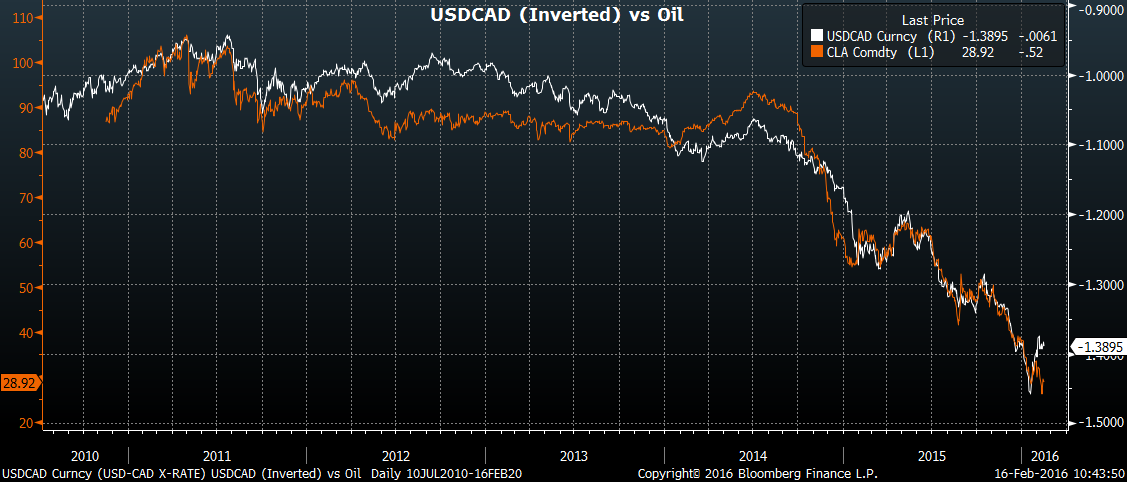
Opportunity: Oil & CAD Convergence Coming?

Traditionally Oil and the Canadian Dollar (“CAD”, or Loonie) have held a strong correlation. To a trader the causation aspect is not of particular interest. In the last few weeks Oil and the Canadian Dollar have diverged significantly. No matter if there is a change in the longer term trend for one or the other, in the next week to two weeks, we would expect to see the gap seen at the right hand side of the below chart converge.

The trade idea is then to go long Oil and short CAD. This way you are mitigating risk of a change in the longer-term trends, and relying on the expected convergence of the price trajectories.

OilCAD

Scott Galloway on The “Gang of Four”

Apple, Google, Facebook, Amazon.  The four technology giants that rule the commercial landscape.  These firms DOMINATE their spaces.  They are not winning, they are crushing.  I did not understand the degree to which they dominate.  They are each multiples, not percentages, ahead of their competition.

This talk by Scott Galloway made me really think about who and what controls my each and every day.

MTP Brokers Go Back In Time

Back in 2007 or so, something happened to the Margin Trading Products (“MTP”, aka FX & CFD Brokers) industry.  The industry’s largest brokers started to offer the MetaTrader 4 trading platform.  By many firms adopting a third-party platform, which was and is still available to almost any startup brokerage, the marketing battle was no longer a comparison of proprietary platforms (with little pricing pressure).  The battle for market share was now a all out price war with spreads being cut and outrageous bonus offerings to clients.  As an Introducing Broker (“IB”) in those times, I benefited as I could easily move client accounts from one brokerage firm, to whichever broker was offering me and my clients the best deal.  Since clients did not have to learn to use a new trading platform if they were to switch brokers (previously a large deterrent to switching brokers), the only defense of market share was price cutting and bonus offers.

But in the last year, with an increasing frequency, we are seeing the large MTP brokers going back in time to focusing on their own proprietary platforms and direct client marketing (bypassing Introducing Brokers).  FXCM (NYSE: FXCM), Gain Capital (NYSE: GCAP), London Capital Group (LSE: LCG) have all made significant efforts in the last 12 months to develop and push their own trading platforms.  This means more in-house technology builds, but a more valuable client when that client chooses to trade on a proprietary platform.  These companies have also worked to increase their direct client marketing to bypass the expense of paying an introducing broker for client accounts and client orders.  At FXCM, 90% of their IB Sales staff have been let go, and Gain Capital has cut as well.  Further we see London Capital Group buying a trading platform company 4 months ago and launching the platform as their own this week.

So what is the take away for someone like me who helps operate a smaller brokerage without the global reach or the financing of the largest players? A few thoughts:

  1. The larger players have financial pressures of being public and want to change from a variable cost per client order (IB-focused sales) to a “fixed” cost per client account (direct client-focused sales).  These firms believe their direct marketing efforts are controllable and have a better ROI.
  2. As a smaller firm, I can choose to learn from them and follow their lead, or I can look to take over the network of Introducing Brokers that are being cut by the large players.
  3. Finally, I need to think about the trading platform(s) that we offer.  Do we continue offering a third-party platform as our primary offering?  The marketplace currently demands that platform (MetaTrader4).  But I need to think about what our secondary platform is, and if we have the capabilities to either buy and operate an outside platform, or build our own.  **I am well-aware that running a brokerage is much different than running a software firm**

So what will we do?  We will ensure all our marketing campaigns have two-tiered approaches so that we can maintain and grow our IB network, but also increase our direct client marketing efforts.  that process is simple, but not easy as it is more work to do.  As for platforms and our dependence on a single, third-party platform at this time, I am leaning towards adding a second (though still third-party) platform as a differentiation from our competitors.  While not an ideal offering, I am not at a stage to build our own platform.  So finding a qualified platform that is not yet well-adopted by my competitors is on my to-do list for Qtr 1, 2016.


Who is Minding the Desk?

One of the largest Margin Trading Product (“MTP”) brokers on the planet, DMM Securities of Japan, has announced their Australian subsidiary will stop taking and executing client orders around news events.  DMM is not specific exactly which news event will be excluded.  This is an incredible change of policy; news events create some of the highest-volume moments of each trading day / week / month.  This is like Target or Walmart deciding to close it’s stores on Black Friday here in the US.

The reason for this change can be boiled down to one of two reasons; DMM’s technology stack can not handle the massive spike in volumes around news events/releases, or their risk management practices are failing them.

I am not privy to DMM’s risk management practices.  They may be acting as an agency model and passing on all risk to aggregated counter parties which generates revenues by adding a mark up or a commission to each execution.  If this is their risk model, then the only reason to shut down trading during the busiest moments of the month is their technology stack can not process the tens of thousands of requests and execution confirms correctly.  Though they may be passing on all market risk to their own LP’s, the retail clients face DMM as the counter party.  And therefore DMM is likely on the hook for any technology failures that results in losses or missed potential gains from client orders/executions that are mishandled.  I am sure DMM’s account application documents state that DMM is not liable to their clients for any mishandled orders or failed technology; all brokerage firms include language as such.  Therefore if they are using an agency model, and still terminating trading during these news release moments, the technology failures can be expected to be massive.  Enough so that clients who have signed agreements absolving DMM of liability have strong cases that DMM’s technology failures are blatant, observable, and could have, SHOULD have been fixed.

The other possibility is that DMM operates on a principal basis and DMM has a dealing desk taking the other side of client orders and running a risk book on their desk.  (This post is not here to pass judgement on either an agency or principal revenue model; the most capital and human resource efficient brokers use a combination of agency and principal models).  If DMM is working on a principal basis and is turning off trading during news events, it is likely that their risk team has had large losses on news events.

I have worked as a dealer and as a risk manager on active desks.  And I can state from personal experience, and from the information I see on a weekly basis as a provider of technology to MTP brokerage firms around the globe, that news events are normally cash cows for principal-basis brokerage firms.  There are numerous reasons brokers tend to cash in during news events (spreads widen, over-leveraged clients react poorly, etc).  In fact I have seen risk desks have the most success during news events by applying a “hand’s off” rule (dealers can not execute hedging or prop trades for the 10 seconds prior to, and 20 seconds after a news release)  This “hand’s off” rule assumes the client flow will be fairly neutral and be executed over widened spreads.  The likely reasons for a principal-basis brokerage to lose money during news events are slow technology, or most likely, poor risk management practices.

The good news is that risk management practices can be changed quickly.  The bad news is a broker’s cost model of paying rebates to third parties for introducing order flow, fixed investment costs, or even direct variable costs are not easy to change.  So even though the risk/revenue mix can be changed quickly, the new revenue model may not support the cost structure of the brokerage.  Hopefully this change at DMM is a temporary change and the company can re-organize their risk management model in a way that still supports their cost model, yet allows for them to operate during the busiest time of the markets.

Will Currency Carry Trades Stage a Reverse Comeback?

In July of 2007, the British Pound (“GBP”) vs the Japanese Yen (“JPY”) hit a price of 251.  That is, a single British Pound would get you 251 Japanese Yen.  It was a great time for UK residents to visit Japan.

By January of 2012, that same British Pound would only get you 119 Japanese Yen.  The relative value of the GBP vs the JPY had fallen be more than 50% in just four and a half years.  This time period saw numerous wealthy Japanese residents buying London properties with their (relatively) stronger Yen.

The macro forces that drove the GBP/JPY higher in the early and mid-2000’s was an expectation of rising short term interest rates in the UK (6% and trending higher), and the expectation for falling short term interest rates in Japan (0.3% and trending lower).  Essentially you could borrow cheaply in Japan and invest at higher rates in the UK.  This is what drove the currency pair to new highs.

And now we see the European Union’s Central Bank promising to fight deflation by lowering short term interest rates.  And on the other side of the world, the Bank of Japan is promising to do increase inflation rates in Japan by any means necessary.

So if the EU is actively dropping interest rates, and the BOJ is working to increase interest rates, is it possible that this year’s carry trade will be long JPY and short EUR?